There’s a line I hear in almost every first conversation with a founder or CEO:
“We need a CMO, but we can’t afford one. And honestly, I’m not sure we even have enough work to justify a full-time hire.”
Ten years ago, that sentence ended the conversation. The company either stretched to pay a full-time executive they didn’t quite need, promoted someone internally who wasn’t quite ready, or — most often — kept limping along with the CEO pretending to own a function they had no time for.
I wrote a book called The Unstuck Method partly because I kept watching brilliant founders get stuck in exactly this place. Not because they weren’t smart enough to solve it, but because the hiring model gave them only two options — full-time executive or no executive — and neither was the right answer for where they were.
Today, that sentence is the beginning of a very different conversation. One that usually ends with the company getting the exact leadership they need, at a fraction of the cost, in a structure that actually fits the stage they’re in.
Welcome to the fractional executive model. It’s not a trend. It’s a permanent restructuring of how growth-stage companies buy senior leadership — and if you’re not thinking about it seriously, you’re quietly handing an advantage to your competitors.
What a Fractional Executive Actually Is (And Isn’t)
Let’s kill the confusion first, because the market is full of people using the word “fractional” to mean whatever they want it to mean.
A fractional executive is a senior operator — typically 15+ years in a specific function — who serves as the actual, accountable head of that function inside your company on a part-time, ongoing basis. Usually 8 to 20 hours per week. Usually for 6 to 24 months.
Usually with a seat at the leadership table, not outside it.
That last part is what separates fractional from the adjacent categories people keep confusing it with:
A consultant tells you what to do and leaves. A fractional executive owns the outcome.
An agency executes tactics inside a scope of work. A fractional executive sets the strategy those tactics should serve.
An advisor shows up for a monthly call and gets paid in equity or a small retainer. A fractional executive is in your Slack, in your standups, in your board meetings.
The distinction matters because it’s the entire reason the model works. You’re not buying advice. You’re buying a senior leader who happens to be shared across a small number of companies.
Why Now
Three things happened at roughly the same time, and the fractional model is the consequence of all of them colliding.
First, the cost of a real senior executive got absurd. A competent VP of Marketing in a mid-size metro is now $220K–$280K base, plus bonus, plus equity, plus benefits, plus the recruiter fee to find them. You’re into $400K all-in before they’ve written a single brief. For a company doing $3M–$15M in revenue, that’s an unjustifiable line item — and yet those are exactly the companies that most need senior marketing leadership to break through to the next stage.
Second, senior operators got tired. Twenty-five years of climbing someone else’s org chart, absorbing someone else’s politics, being the one person on vacation answering Slack — a huge cohort of accomplished executives in their 40s and 50s looked up around 2020 and decided they’d rather work with three great companies than one mediocre one. The supply side of fractional talent exploded almost overnight.
Third, remote work removed the last objection. Nobody’s asking the CMO to be in the office on Tuesday anymore. Which means the CMO can be in Austin, serve three companies, and nobody loses anything meaningful in the process.
Put those together and you get what’s happening now: the middle of the executive labor market is being rebuilt around shared, part-time, senior leadership. It’s not going back.
The Ownership Gap: The Diagnostic Every Founder Should Run
After a decade of watching these engagements succeed and fail, I’ve come to believe there’s one question that predicts everything else:
Which functions in your company have real senior ownership — and which ones are you pretending are covered?
I call this the Ownership Gap. It’s the space between the functions your business needs run at a senior level and the functions that actually are.
Here’s how to run it on your own company. Take ten minutes with a blank sheet of paper and list every function your business depends on: marketing, sales, finance, operations, product, HR, technology, customer success. Beside each one, write the name of the person who owns it — not helps with it, not contributes to it, owns the strategy and the outcome.
Now mark each name with one of three labels:
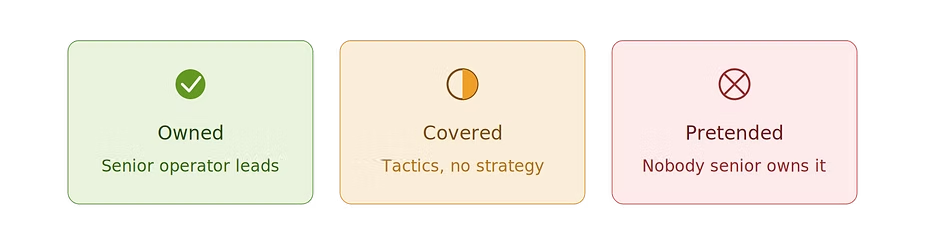
Owned. A genuinely senior operator with 10+ years of relevant function experience who has the authority and the bandwidth to lead it.
Covered. Someone competent is running the tactics, but nobody senior is setting the strategy. This is usually a mid-level employee doing their best without the experience to see around corners.
Pretended. The CEO’s name is on it. Or the COO’s. Or a founder who once did this function at a previous company a decade ago. Or nobody’s name at all, and the function is running on autopilot.
Every “Covered” or “Pretended” on your list is an Ownership Gap. And every gap is costing you money right now — in missed opportunities, bad hires, drifted strategy, or compounding tactical debt.
The fractional model exists because those gaps used to have only two solutions: close them with a $400K full-time hire, or leave them open. Neither was acceptable. Now there’s a third door.
What This Actually Looks Like
Here’s one I ran myself.
A home inspection company came to me doing roughly $1.2M a year with five inspectors — and a calendar booked three weeks out because they couldn’t keep up with the demand they already had. Good problem on paper. Catastrophic problem in practice: every week they were turning away fifteen to twenty inspections they couldn’t service, and every one of those turnaways handed a realtor to a competitor.
When we ran the Ownership Gap on the company, two functions came back Pretended — operations and marketing. The ops function was a whiteboard calendar and a group text thread. The marketing function was whatever the founder had energy for after field work.
The engagement: fractional CEO, six months, operations and marketing rebuilt in parallel.
On the ops side. We moved off whiteboard scheduling onto dedicated inspection software with automated route optimization. Built a fourteen-day structured onboarding program so we could train new inspectors in parallel instead of one at a time. Shifted from a pure 1099 model to a W-2 + 1099 hybrid that let us hire A-players and control quality without killing margins. Launched a tiered service menu — base inspection, premium with thermal imaging, full package with radon and mold — which took average ticket from roughly $385 to roughly $575 without adding a minute of inspector time.
On the marketing side. Stood up a realtor partnership program — monthly lunch-and-learns, co-branded buyer packets, a dedicated realtor portal that booked same-day when their client needed speed. Dominated local SEO across eighteen service-area towns with individual town pages and Google Business Profile optimization on every one. Turned on Google Local Services Ads in the highest-margin zip codes. Rebuilt the review engine with an automated post-inspection request sequence and took the company from 34 Google reviews to 287 in six months.
The outcome. Five inspectors to thirty. Revenue up 300%. Average ticket up roughly 50%. Realtor-referred share of revenue climbed from 38% to 61%. The calendar stopped being the bottleneck. The founder stopped doing inspections and started running the company he’d built. Today it’s a seven-figure operation with a real operations team, a real marketing engine, and a CEO who can take a weekend off.
That’s what closing an Ownership Gap looks like when you do it right.
“You’re not buying advice. You’re buying a senior leader who happens to be shared across a small number of companies.”
When Fractional Is the Right Answer
I’ll give you the honest version, because the people selling fractional services tend not to.
Fractional is the right call when you have a real function that needs real leadership, but the volume of work doesn’t yet justify a full-time seat. Marketing in a $5M company. Finance in a pre-Series A startup. Operations in a founder-led business that just crossed forty employees. HR in a company that keeps losing good people and doesn’t know why.
It’s also the right call during transitions. You just lost your CMO and the replacement search will take five months — a fractional keeps the function running and, frankly, often uncovers why the last person didn’t work out. You’re preparing to sell in eighteen months and need a real CFO to clean up the books for diligence. You’re expanding into a new channel and need someone who’s done it before to lead the initial push.
And it’s the right call when you genuinely don’t know what you need yet. Hiring a full-time VP before you understand the shape of the problem is how companies end up firing that VP nine months later. A fractional executive will diagnose the actual problem, build the role description the full-timer should eventually fill, and hand off cleanly. That handoff, done well, is one of the highest-ROI things a fractional can do.
When Fractional Is the Wrong Answer
I’d rather turn a client away than take money for an engagement that was never going to work. Here’s where fractional fails:
When you need someone in the building eight hours a day to hold a team together, you need a full-timer. No fifteen-hour-a-week executive can substitute for presence when presence is the actual job.
When the work is genuinely tactical — you need someone to run your ad accounts, write emails, build landing pages — hire an agency or a senior IC. Fractional executives are expensive as implementers because they’re priced as leaders.
When your leadership team isn’t ready to share authority with someone who isn’t “one of us.” I’ve walked away from engagements where I could tell the CEO wanted a fractional CMO but the COO wanted a contractor they could order around. That engagement was going to fail in month two. Better to name it in week one.
How to Actually Structure the Engagement
This is where most fractional relationships go sideways, and it’s almost always fixable with a better structure on day one.
Get the hours right. Most functions need 10–15 hours per week to be led well. Less than eight and you’re buying advice, not leadership. More than twenty-five and you should probably be hiring full-time.
Define the first 90 days before you sign anything. A serious fractional executive will walk in with a diagnostic framework, a stakeholder interview plan, and a set of deliverables for the first quarter. If they can’t tell you what month one looks like, they’re not senior enough.
Give them real authority. If the fractional CMO can’t approve a campaign without three layers of internal review, you’ve recreated the exact dysfunction that made you need outside leadership in the first place.
Put an off-ramp in the contract. The best fractional engagements end — either because the company grew into a full-time role, the function got built out, or the work is done. Engagements that drift on for years without a clear “why are we still doing this” conversation are red flags on both sides.
Pay a real rate. I’ll be direct: the market rate for a genuinely senior fractional executive runs $6K–$15K per month depending on function, seniority, and hours. If someone’s pitching you fractional C-suite leadership for $2,500 per month, they’re either desperate, inexperienced, or about to be distracted by the next client who pays more. You’re not saving money — you’re buying a problem.
The Result, When It Works
Here’s what a well-run fractional engagement looks like twelve months in:
The function has a strategy the whole leadership team can articulate. There’s a scorecard with three to five numbers that actually move the business. There’s a team — sometimes two people, sometimes twenty — that knows what they’re doing and why.
There’s a playbook so the next person, fractional or full-time, doesn’t have to start from zero. And the CEO has stopped waking up at 3 a.m. worrying about that function, because somebody senior actually owns it.
That’s the whole product. Not hours. Not deliverables. Not decks. Senior ownership of a function, compressed into the slice of time your company actually needs.
Run the Ownership Gap Diagnostic on Your Business
The real question isn’t “should I hire a fractional executive.” It’s which Ownership Gap in my business is costing me the most every month I pretend otherwise?
If you want to run the full diagnostic on your company, I do these calls personally through The Mangione Group. It’s twenty-five minutes. No pitch, no deck, no follow-up sequence trying to sell you anything. You walk me through your org, I ask the questions that surface the gaps, and you leave with a written ranking of your three most expensive
Ownership Gaps — and whether each one is actually a fractional fit or a different kind of hire.
If we’re the right partner to close one of those gaps, we’ll talk about that after. If we’re not, I’ll tell you who is.
Book the Ownership Gap Diagnostic →
Frequently Asked Questions
What’s the difference between a fractional executive and a consultant?
A consultant delivers recommendations and leaves. A fractional executive owns the outcome. Consultants produce reports; fractional executives sit in your leadership meetings, run your function day to day, hire and manage your team, and report on the same numbers a full-time executive would. The monthly pricing can look similar, but the accountability model is fundamentally different — a fractional executive’s success is measured in the same terms as the full-timer they’re replacing or preceding.
How much does a fractional executive cost?
The market rate for a genuinely senior fractional executive ranges from $6,000 to $15,000 per month, depending on function, seniority, and weekly hours committed (typically 8–20 hours per week). Fractional CFO and CTO engagements tend to sit at the upper end of that range; fractional CMOs and COOs typically fall in the middle; specialized roles like Head of People or Head of Revenue can vary widely. Engagements priced below $4,000 per month usually are not getting you a senior executive — they’re getting you an overworked consultant or an inexperienced one.
How long should a fractional engagement last?
Most successful fractional engagements run six to twenty-four months. Shorter than six months rarely gives the executive enough time to diagnose the function, build the strategy, and hand off cleanly. Longer than twenty-four months usually means one of two things: the role has grown into a legitimate full-time seat and you should hire for it, or the engagement has quietly drifted and nobody’s said so out loud. Build a 90-day checkpoint and a twelve-month review into every fractional contract you sign.