The first question isn’t who to hire. It’s what kind of help to buy.
Most founders get this wrong, and they get it wrong expensively. They feel the pain of a gap in the business — sales are flat, marketing is scattered, operations is breaking, the numbers don’t reconcile — and their instinct is to reach for whichever outside resource comes to mind first. A consultant, if they’ve heard a good pitch. An agency, if the problem feels like a channel. An interim, if someone just resigned. A fractional executive, if a peer in a CEO group recommended one.
The result is a pattern I’ve watched repeat for twelve years: a founder spends $50,000, $150,000, sometimes $400,000 on the wrong kind of help for the problem they actually have — and then concludes that outside help doesn’t work. It’s not that outside help doesn’t work. It’s that they bought the wrong category of it.
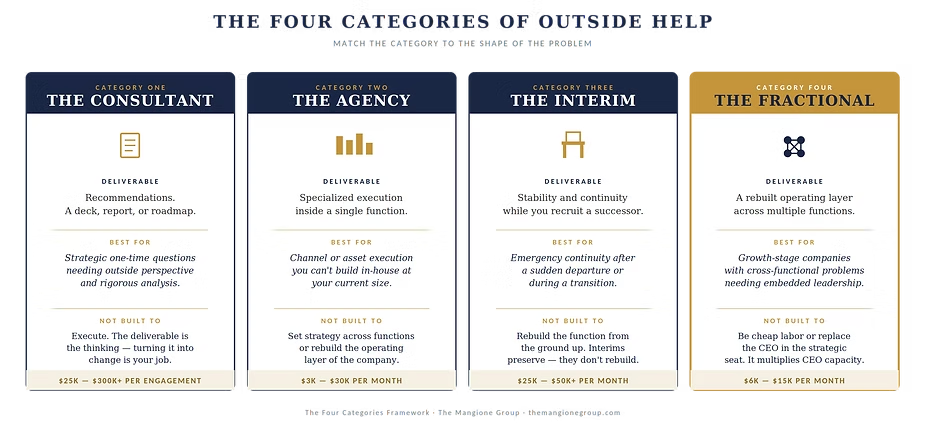
The four options — fractional executive, consultant, agency, interim executive — look similar from twenty feet away. Up close they are almost nothing alike. They have different economics, different time horizons, different authority structures, different deliverables, and different failure modes. Matching the right category to the right problem is one of the highest-leverage decisions a founder makes, and almost nobody teaches it.
This piece is that decision framework. I’ll define each of the four cleanly, map the specific problems each one actually solves, show you the categorical mistakes founders make when they cross-wire them, and give you a one-page diagnostic you can use the next time you feel the pull to reach for outside help.
The goal isn’t to convince you to hire a fractional executive. I’ll tell you plainly when you shouldn’t. The goal is to make sure that whatever you hire next actually matches the shape of the problem you have.
Table of Contents
Why Founders Misbuy Outside Help
The outside-help economy is enormous and getting bigger. The global management consulting market alone is approaching $510 billion and projected to hit $721 billion by 2032, according to Fortune Business Insights. Layer in marketing agencies, interim executive placement firms, and the rapidly growing fractional market, and you’re looking at well over a trillion dollars a year in services founders can theoretically buy. The U.S. Bureau of Labor Statistics counts roughly 840,000 management consultants working in the United States alone.
Against that much supply, making the right choice is harder, not easier. Every category has its own sales narrative. Every category has its own category-defining firms that have trained the market to think their shape of help is the default. Every category has a vested interest in making you believe the problem you have is the problem they solve.
Meanwhile, the economic stakes keep getting higher. According to Focus Digital’s 2026 agency benchmark report, marketing agencies see 28–42% annual client churn, and roughly 40% of brands part ways with their agency within the first six months. Those aren’t signs of a broken industry. They’re signs of a category mismatch — companies buying agency work when they actually needed something else, discovering the mismatch 90 days in, and eating the cost.
The four categories exist for a reason. Each one was built to solve a specific shape of problem. Buying the right category for your actual situation is cheaper, faster, and more effective than buying the wrong one and correcting later. Buying the wrong one is how founders end up $250,000 in with nothing to show for it.
So let’s get the categories straight.
The Four Categories, Defined Cleanly
Here is the cleanest distinction between the four, stripped of the marketing language each industry uses to blur the lines.
-
A consultant gives you advice. Deliverable is recommendations. You execute.
-
An agency executes work in one function. Deliverable is campaigns, assets, or outputs in that function. Strategy is usually limited to that function.
-
An interim executive fills a full-time seat temporarily. Deliverable is stability and operational continuity while you recruit a permanent leader.
-
A fractional executive embeds as ongoing leadership across the operating layer. Deliverable is rebuilt systems, aligned functions, and lasting playbooks.
Every other distinction — price, duration, reporting structure, day-rate vs. retainer, onsite vs. remote — flows from those four core differences. Let’s go deeper on each.
The Consultant
What they actually do: Diagnose a specific problem and hand you a recommendation. The deliverable is a deck, a report, a roadmap, or a set of frameworks. The execution is yours.
What they’re best at: Strategic one-time questions that need outside perspective and rigorous analysis. Should we enter this new market? Is our pricing structure leaving money on the table? What does the competitive landscape look like in this segment?
How do we think about this M&A opportunity? Consultants at the high end bring deep pattern recognition across many clients and real analytical horsepower. They are genuinely good at clarifying ambiguous strategic questions.
Typical engagement shape: 6 to 16 weeks, often fixed-fee or fixed-milestone. Scoped tightly around a specific question. Deliverables are formal.
Typical economics: Varies wildly. A solo senior consultant might charge $25K–$75K for a focused engagement. Big-firm consulting engagements run from $150K to millions. The distribution is enormous.
What they are NOT built to do: Execute. This is the single biggest source of misunderstanding. The consulting deliverable is the thinking. Turning that thinking into operational reality inside your business is not their job. If the strategy requires hiring, firing, rebuilding systems, retraining teams, or changing how the company runs day to day, that work is yours — not theirs.
How the category fails: You get a beautiful deck and nothing changes. Six months later the deck is in a drawer, the recommendations were never executed, and the business is in the same place but $80K lighter. This is not because the consultant was bad. It’s because nobody inside the company had the capacity, authority, or system-building skill to turn the advice into change.
The Agency
What they actually do: Execute specialized work in a single function — typically marketing, sometimes sales, creative, or technology. The deliverable is the output: ads running, content shipping, SEO improving, campaigns launching, websites built.
What they’re best at: Channel-specific or asset-specific execution you can’t reasonably build in-house at your size. A good paid media agency will outperform most internal generalists at paid media. A good content agency will produce better content than your internal team likely has capacity to produce. Agencies scale execution capacity fast.
Typical engagement shape: Monthly retainer or project fee. Ongoing relationships typically run 12–36 months, though as noted above, a large share of engagements end inside the first six months due to mismatched expectations.
Typical economics: Marketing agency retainers commonly run $3K–$30K per month depending on scope. Specialized agencies (enterprise PPC, enterprise SEO, performance creative) run higher.
What they are NOT built to do: Own your business strategy. Own the coordination between marketing and sales and operations. Rebuild the operating layer of the company. Agencies are best when dropped into a business that already has a clear strategy — they execute inside that strategy. They struggle, and often fail, when a company hires them hoping they’ll set the strategy. That’s not their role, even though many of them will take the brief.
How the category fails: The founder feels something is off across the whole business and hires a marketing agency because marketing feels like the visible problem. Six months later the ads are running fine, the content is shipping, the SEO is creeping up — and revenue hasn’t moved, because the actual problem was that sales and operations weren’t wired to convert what marketing was bringing in. The agency did its job. The job wasn’t the problem.
The Interim Executive
What they actually do: Step into a full-time executive seat on a temporary basis, usually after a sudden departure or during a transition. The deliverable is stability — the function keeps running, the team stays intact, critical decisions get made, while the company recruits a permanent hire.
What they’re best at: Emergency continuity. Your CFO quit four weeks before board materials are due. Your COO left mid-integration of an acquisition. Your CMO resigned and a product launch is two months out. An interim executive is a bridge — they keep the function functional while you conduct a proper search.
Typical engagement shape: 3 to 9 months, full-time hours, often on the company’s payroll or through a staffing firm. Clear handoff to the permanent hire at the end.
Typical economics: Often comparable to the full-time salary of the role they’re filling, sometimes with a premium for the temporary nature of the work. A genuine C-suite interim typically costs $25K–$50K+ per month fully loaded.
What they are NOT built to do: Rebuild the function from the ground up. Redesign the operating model. Introduce structural changes that will outlast their tenure. An interim is a caretaker — they preserve, they stabilize, they prevent damage. They are not hired to reimagine.
How the category fails: The company uses an interim as a cheap substitute for either a real full-time hire or a fractional executive, expecting them to solve deep structural problems in the function. Interims usually won’t take that swing — it’s not what they signed up for and it’s not what they’re paid to do. The company ends up with nine months of preserved status quo and the same underlying dysfunction that prompted the original search.
The Fractional Executive
What they actually do: Embed as ongoing senior leadership across the operating layer of the business. Not a specialist in one function — a senior operator aligning multiple functions around a coherent strategy, rebuilding systems that don’t exist, and installing playbooks the team can keep running after the engagement ends.
What they’re best at: Growth-stage companies ($1M–$25M in revenue) that have outgrown their original operating layer. Companies that need executive-level thinking and execution capacity at the same time. Companies that need someone to diagnose and to build. Companies where the problem spans multiple functions and no single-function hire will fix it.
This is the category I work in, so I’ll spend a moment being precise about it. A fractional executive is not a consultant with a longer contract. They are not a part-time employee. They are not a coach, not an advisor, and not a freelancer. A fractional executive is embedded leadership — someone who makes real decisions, leads people, builds systems, and owns outcomes inside the business, across multiple companies simultaneously, on a shared-time basis. The full picture of what this category actually involves is covered in our definitive guide to fractional leadership and our piece on the quiet revolution in the C-suite.
Typical engagement shape: 6–18 months of active embedded work, typically 1–3 days per week plus asynchronous support, often with a longer advisory tail. Scope-based pricing, not hourly.
Typical economics: $6,000–$15,000 per month depending on scope. Anything materially below $4,000 per month is not a senior executive — it’s someone cheaper wearing the label. The category is growing fast: the U.S. Bureau of Labor Statistics has tracked a 57% increase in temporary business management roles since 2020, and the global fractional executive market has crossed $5.7 billion and is growing at 14% annually.
What they are NOT built to do: Be your cheap labor. Run your company for you while you disengage. Replace the CEO in the strategic seat. A fractional executive multiplies CEO capacity — they do not substitute for it. The first two weeks of any serious fractional engagement require the CEO’s fingerprints on the strategy. Without that, the engagement doesn’t work.
How the category fails: When founders treat it like cheap consulting and disengage, or treat it like a staff augmentation and expect a senior operator to take orders. The category works when the CEO wants a peer-level partner with authority to reshape the operating layer.
The Decision Framework: Which One Fits Your Problem
Strip away the marketing language and the decision gets much simpler. Four questions, answered honestly, will tell you which category of help you actually need.
Question 1: Do you need advice, or do you need change? If you need someone to help you think through a strategic question and you have the internal team to execute the answer, you need a consultant. If the problem is not “I don’t know what to do” but “I know roughly what needs to happen and it isn’t happening,” you need execution, not advice.
Question 2: Is the problem inside one function, or does it span the operating layer? If the problem is genuinely inside one function — your paid media is underperforming, your website is broken, your SEO is stuck, your creative is stale — an agency is the right answer. If the problem is cross-functional — sales and marketing aren’t aligned, operations can’t absorb what sales is closing, the whole company isn’t compounding — no single-function agency will fix it.
Question 3: Do you need continuity or transformation? If a seat just emptied and you need to keep the function running while you hire a permanent successor, you need an interim executive. If the seat wasn’t working before it emptied — or was never filled to begin with — you don’t need continuity. You need someone to rebuild the function, which is not what an interim is for.
Question 4: Do you need a rebuilt operating layer? If your real answer is our systems worked at $1M and don’t work anymore, nobody on the team has the bandwidth or skill to rebuild them, and the problem touches multiple functions — that’s a fractional executive. That is the exact shape of problem the category exists to solve.
If you’re unsure which question applies, it’s usually because the problem has multiple layers. That’s normal. The next sections show you how to handle that
.
The four categories look similar from twenty feet away. Up close they are almost nothing alike — and the cost of confusing them is measured in quarters, not dollars.
Real Engagement: When Fractional Was the Right Call
Abstract frameworks only matter if they map onto real decisions. Here’s one that did.
LFC came to me surviving, not thriving. Revenue was real. Customers were real. The business was working, in the sense that it hadn’t failed. But it had stopped growing, and the founder was burned out trying to figure out why.
]On the surface, it looked like a marketing problem. Leads had flattened. The obvious move — the one almost every founder would have made first — was to hire a marketing agency, pump more into ads, and see if the funnel loosened up.
It would not have worked. Because the problem wasn’t actually marketing. The problem was that sales, marketing, and operations all ran through the founder, nobody owned the handoffs between them, and there was no operating layer that could absorb any additional volume even if marketing had produced it. A marketing agency would have shipped great campaigns into a broken system.
What LFC actually needed was a fractional executive — someone to rebuild the operating layer across multiple functions in parallel, stand up the systems, and hand the founder back a company that could run without being a full-time extension of one person.
In six months of the engagement:
-
↑ 82% sales growth — directly from the rebuilt operating layer, not additional ad spend
-
↓ 35% reduction in manual workload — systems that used to live in the founder’s head, codified and delegated
-
+ $100,000+ in new monthly revenue — a business that was surviving, now genuinely compounding
No new office. No rebrand. No massive ad spend. The breakthrough came from matching the right category of help to the actual shape of the problem. A consultant’s deck wouldn’t have done it. An agency wouldn’t have done it. An interim holding the seat wouldn’t have done it. The problem was cross-functional, execution-heavy, and required embedded ongoing leadership. That is the fractional category, exactly.
If LFC had spent the same six months with any of the other three categories, the business would likely still be stuck.
The Four Most Expensive Category Mistakes
Twelve years of watching founders make these decisions, the same four mistakes show up over and over. Each one costs real money, and each one is preventable once you know what to look for.
Mistake 1: Hiring an agency when you needed a fractional executive. Symptom: the founder feels pain across the whole business but names it as a “marketing problem” and hires an agency. The agency does its job. The business doesn’t improve. After 6–12 months the founder concludes “marketing doesn’t work for us” when the actual issue was that the operating layer couldn’t absorb what marketing was producing. Typical cost: $50K–$200K over the engagement, plus another 6–12 months of lost growth.
Mistake 2: Hiring a consultant when you needed a fractional executive. Symptom: the founder hires a strategy firm, gets a beautiful roadmap, has no internal capacity or authority structure to execute it, and watches the deck gather dust. The strategy was often directionally right. The execution layer simply didn’t exist. Typical cost: $75K–$300K plus the opportunity cost of a year of non-execution.
Mistake 3: Hiring a fractional executive when you needed a consultant. Symptom: the founder has a genuine one-time strategic question (should we enter this market? should we do this acquisition?) and hires a fractional executive for a 12-month engagement to answer it. Overkill. A fractional’s value compounds over ongoing embedded work — using them for a one-shot strategic question is expensive relative to the alternative. Typical cost: a year of retainer when a 6-week consulting engagement would have sufficed.
Mistake 4: Hiring an interim when you needed a fractional executive (or vice versa). Symptom: the founder loses a CFO, hires an interim, and expects them to “clean up the finance function” while they’re there. The interim stabilizes but doesn’t transform. Nine months later, the company hires a permanent CFO who inherits the same structural mess. The reverse also happens — a company with a stable function hires a fractional to rebuild something that didn’t actually need rebuilding, just continuity during a transition. Typical cost: 6–12 months of mismatched scope plus the cost of eventually hiring the right category.
Most founders make at least one of these mistakes. The expensive ones make two or three in a row before catching the pattern.
A One-Page Diagnostic
Before you hire anyone in any of the four categories, walk through this sequence.
-
Name the problem in one sentence, with no jargon. Not “our marketing is underperforming.” Say what’s actually happening. “We’re spending $20K/month on marketing, getting leads, and not converting them into revenue at a predictable rate.” Precise problem statements pick their own categories.
-
Ask whether the problem is single-function or cross-function. Single-function problems get single-function help (agency, specialist consultant). Cross-function problems get cross-function help (fractional, strategic consultant).
-
Ask whether you need advice or change. Advice problems get consultants. Change problems get operators.
-
Ask whether a seat is empty. An empty seat + need for continuity = interim. An empty seat + need for transformation = fractional. A full seat + broken systems around it = fractional.
-
Ask what “done” looks like. If “done” is a deliverable (a deck, a report, a campaign), you need a consultant or agency. If “done” is a different-shaped company, you need an operator.
-
Match the category. Once you have honest answers to the five questions above, the right category is usually obvious. The mistake is skipping the questions and reaching for the first category that comes to mind.
If you walk through this and the answer is a fractional executive, the next question is which fractional executive and how to structure the engagement — which is a different set of questions I’ve covered in depth in the Quiet Revolution piece. If the answer is something else, hire something else. The worst outcome isn’t picking a category I don’t work in. The worst outcome is picking the wrong category, period.
When You Genuinely Need More Than One
Some problems don’t fit neatly into one box. Here’s when combining categories actually works — and when it’s a red flag that you haven’t diagnosed clearly enough.
Fractional + Agency: Common and effective. The fractional executive sets the strategy and owns the cross-functional operating layer; the agency executes specialized channel work inside that strategy. The fractional executive manages the agency so the agency isn’t asked to set direction they aren’t built to set. This is the most common successful combination I see.
Fractional + Consultant: Occasionally useful. A fractional engagement uncovers a specific strategic question the company needs deep analytical horsepower on — pricing restructure, M&A question, market entry — and a consultant is brought in for a focused engagement to answer that specific question. The fractional then owns execution of the recommendation.
Interim + Fractional: Rare but works when a function has collapsed, an interim is needed immediately for continuity, and a fractional is brought in concurrently at a higher layer to rebuild the broader operating model. The interim holds the seat; the fractional redesigns the whole system the seat sits inside.
Consultant + Agency without operator leadership: The most common failure pattern masquerading as a solution. Founder hires both, nothing integrates, both deliver their outputs, nothing changes. If you’re tempted to hire a consultant and an agency, ask first whether you actually need a fractional executive to own the integration.
The rule: more categories = more coordination cost. Only stack them when each is genuinely doing a different job and someone is accountable for the integration.
Find the Right Fit Before You Spend a Dollar
If you’ve read this far, odds are you’re sitting on a decision right now — a gap in the business, a pile of outside-help options, and a nagging sense that you’re about to spend real money without being fully sure it’s the right kind of money to spend.
I run a call called the Ownership Gap Diagnostic. No pitch, no deck, no follow-up sequence. You walk away with a written ranking of the three most expensive ownership gaps in your business and a clear read on which category of outside help — fractional, consultant, agency, or interim — is actually the right fit for each gap.
If a fractional engagement is the right answer, we’ll talk about it. If an agency, a consultant, or an interim is the right answer, I’ll tell you plainly. I’d rather send you to the right category than take an engagement that won’t work.
Book the Ownership Gap Diagnostic →
That’s the whole call.
Frequently Asked Questions
What is the main difference between a fractional executive and a consultant?
A consultant gives you advice; a fractional executive embeds and runs the work. The deliverable of a consulting engagement is a recommendation — a strategy, a diagnosis, a roadmap — which you then execute with your own team. The deliverable of a fractional engagement is an actually-changed business: rebuilt systems, aligned functions, hired and trained people, playbooks that outlast the engagement. A useful shorthand: you hire a consultant when you need to decide what to do, and you hire a fractional executive when you need someone to embed and make it happen across multiple functions simultaneously.
When is a marketing agency a better fit than a fractional CMO?
A marketing agency is the right fit when you have a clear marketing strategy, you know which channels matter, and you need specialized execution capacity in one or more of those channels. A fractional CMO — or more often, a fractional executive with marketing inside a broader scope — is the right fit when the marketing problem is actually a cross-functional problem (marketing producing leads that sales can’t convert, or marketing promising outcomes operations can’t deliver), or when you don’t yet have a marketing strategy at all. The test: if you know exactly what you want executed, hire the agency. If you don’t yet know what should be executed, hire the strategic leadership first.
How is a fractional executive different from an interim executive?
An interim executive fills a full-time seat temporarily, usually to maintain continuity while you hire a permanent leader. Their job is to keep the function functional — make decisions, manage the team, prevent damage — for three to nine months. A fractional executive works across multiple companies on a shared-time basis for 6–18 months (often longer), and their job is to transform the operating layer, not just hold it steady. Interims preserve. Fractionals rebuild. You hire an interim when a seat just emptied and you need to bridge to a new hire. You hire a fractional when the problem is structural and rebuilding the system is the actual work.
Can I hire both a fractional executive and an agency?
Yes — this is actually one of the most common successful combinations. The fractional executive owns strategy and the cross-functional operating layer; the agency executes specialized channel or craft work inside that strategy. The fractional typically manages the agency relationship, which prevents the common failure pattern where an agency is asked to set strategy they aren’t built to set. If you’re considering hiring both simultaneously without a fractional or senior internal operator in the middle, that’s usually a sign you need the fractional first — then let them decide whether an agency is the right next move.
What does a fractional executive cost, and how does that compare to the alternatives?
Fractional executive engagements at the senior operator level run $6,000–$15,000 per month depending on scope. A full-time C-suite hire at the same seniority, fully loaded with benefits and equity, is typically $200,000–$500,000+ annually. Management consulting engagements at the small-firm or boutique level commonly run $50,000–$300,000 per engagement for 6–16 weeks of work. Marketing agency retainers commonly run $3,000–$30,000 per month. Interim executives typically cost similar to or slightly more than the full-time salary of the role. The right economic comparison is not which option is cheapest — it’s which option actually solves your problem. Paying $60K for the wrong category of help is more expensive than paying $90K for the right one.
More on pricing and engagement economics in the definitive guide.
Related Reading
-
The Three Ceilings: Why Companies Plateau at $3M, $10M, and $25M — The framework for diagnosing which revenue-band plateau you’re actually at, and what structurally breaks each ceiling.
-
Fractional Executives: The Quiet Revolution in the C-Suite — The companion pillar piece on the Ownership Gap framework and how to structure a fractional engagement correctly.
-
Fractional Executive: The Definitive Guide to Fractional Leadership — The full 11-section guide covering every aspect of the fractional model, from pricing to contracts to role types.
-
Fractional CEO Guide — A deeper look at the fractional CEO specifically and when it’s the right engagement for a plateau breakthrough.
About the Author
Michael Mangione is the founder and CEO of The Mangione Group, a fractional executive firm that aligns sales, marketing, operations, and technology for growth-stage companies stuck between $1M and $25M in revenue. He is the author of The Unstuck Method and the creator of the Ownership Gap Diagnostic and the Three Ceilings framework.
Over twelve years of fractional leadership, Mike has led engagements across real estate, legal, marketing, technology, home services, agriculture, manufacturing, and professional services. The Mangione Group deploys a bench of 20+ specialized operators — including a 20-year operations expert and 25+ marketing specialists — to deliver full-time outcomes on fractional time.
The Mangione Group has cultivated a powerful network of professionals whose insights have been featured in The New York Times, CNN, Fortune, Entrepreneur, Inc., Bank of America, Ritz-Carlton, Samsung, and more.
Connect: LinkedIn · The Mangione Group · Mike@TheMangioneGroup.com · +1 (844) 435-1656
Sources cited in this article: Fortune Business Insights, Global Management Consulting Services Market forecast (2025); U.S. Bureau of Labor Statistics data on management consultants and temporary business management roles; Focus Digital, Marketing Agency Churn Benchmark Report 2026; industry research on the global fractional executive market.